Why Advanced Food & Beverage Service Simulation Defines Modern Hospitality Education
The contemporary hospitality industry is no longer limited to merely providing accommodation and meals. Instead, it has evolved into a highly sophisticated service ecosystem. In this dynamic space, guest experience, operational efficiency, technological integration, sustainability, and personalized service determine organizational success. To achieve this we need the Best Hotel Management College in West Bengal.
Consequently, luxury hotels, international restaurant chains, destination resorts, cruise liners, and multinational hospitality corporations invest heavily in service innovation. They understand that the Food and Beverage (F&B) division contributes significantly to guest satisfaction, brand reputation, and overall profitability.
Revenue metrics are directly influenced by the operational efficiency of the F&B department. These metrics include average guest spending, food cost percentage, beverage yield, customer lifetime value, and service quality indices. Therefore, modern hospitality education must replicate these commercial realities.
Institutions must provide realistic simulation laboratories that transform theoretical concepts into professional competence. For students considering Best Hotel Management College in West Bengal, choosing an institution equipped with advanced simulation facilities is a critical career decision. Practical exposure within commercial-style training environments enables learners to understand the intricate relationship between guest psychology and service excellence.
Experiential Learning Over Conventional Classrooms
Unlike conventional classroom education, simulation-based learning allows students to experience authentic hospitality operations. In a controlled academic environment, mistakes become valuable opportunities for professional growth. Furthermore, students planning Hotel management after 12th require educational institutions that emphasize experiential learning rather than rote instruction.
Modern hospitality employers expect graduates to possess deep technical expertise from day one. This includes practical knowledge of restaurant operations, beverage management, banquet execution, and guest communication. Moreover, understanding sustainability practices, menu engineering, and service recovery strategies is absolutely essential before entering industrial training.
These vital competencies are developed only through repeated practical exposure. They require realistic training laboratories designed precisely according to international hospitality standards. Every institution aspiring to become the Best Hotel Management College in West Bengal recognizes that F&B education forms the true backbone of hospitality training.
State-of-the-art simulation facilities cultivate technical precision, emotional intelligence, leadership capabilities, and guest-centric thinking. As a result, such infrastructure empowers graduates to confidently transition into luxury hotels, premium restaurants, cruise hospitality, airline catering, and entrepreneurial ventures.
The Financial Mechanics of F&B Simulation
To truly understand F&B operations, students must grasp the underlying financial metrics that keep a business afloat. Simulation laboratories are not just about carrying trays; they are about understanding the rigorous economics of hospitality. For instance, students learn to calculate vital performance indicators that drive daily restaurant profitability.
A critical metric taught in these advanced simulations is the Food Cost Percentage. This formula dictates exactly how effectively a kitchen manages its inventory, waste, and menu pricing. Students learn this practically, continuously applying the standard equation:
$\text{Food Cost Percentage} = \left( \frac{\text{Beginning Inventory} + \text{Purchases} – \text{Ending Inventory}}{\text{Food Sales}} \right) \times 100$
Similarly, they understand how restaurant performance impacts the overall hotel metrics, such as Revenue Per Available Room (RevPAR). By mastering these financial concepts in a simulated environment, students graduate with the sharp business acumen required by top-tier employers. Therefore, pursuing Hotel Management after 10+2 in a simulation-rich environment ensures that students are not just trained servers, but future business managers.
The Fine Dining Training Restaurant: An Authentic Experience
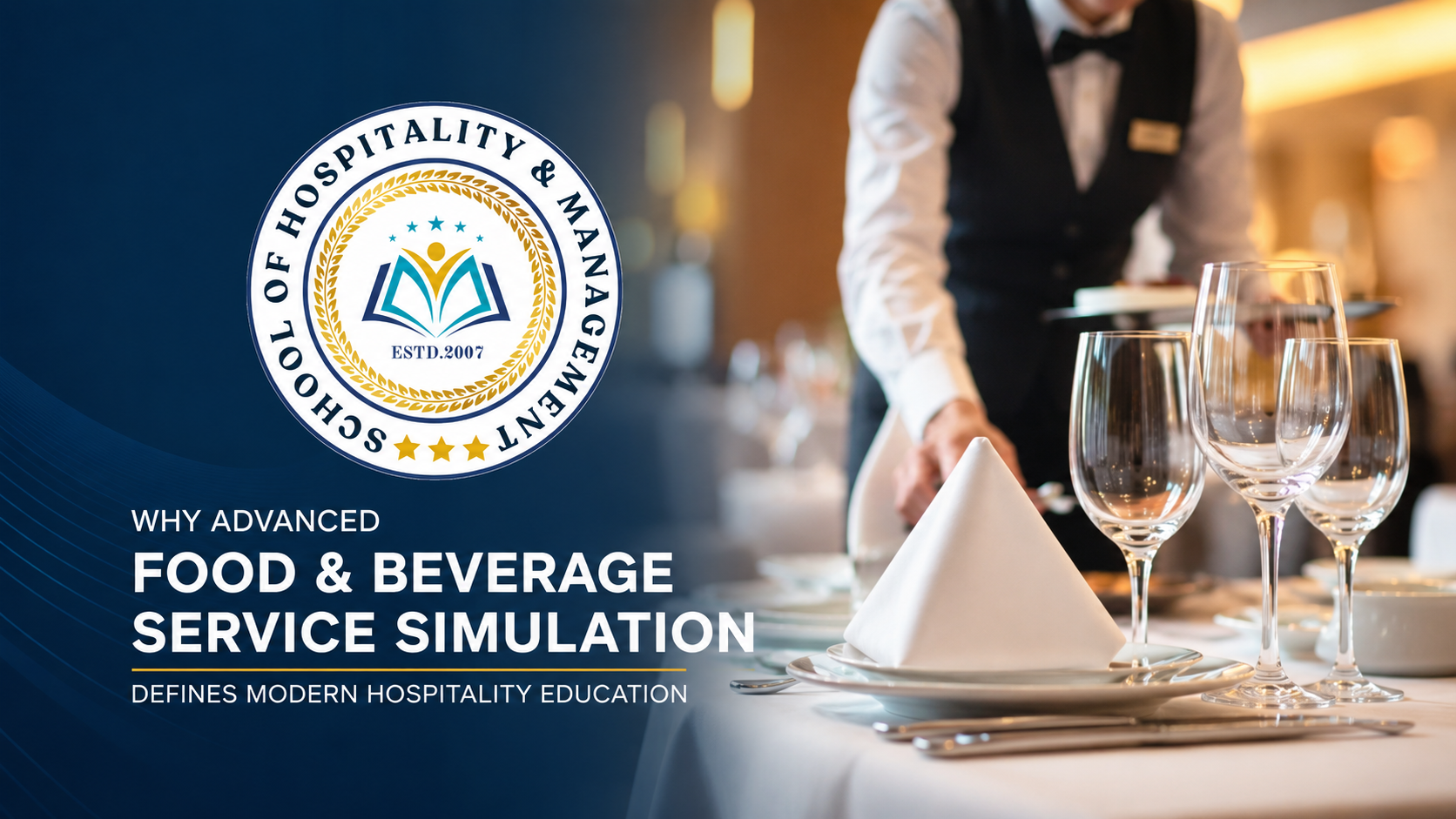
A Fine Dining Training Restaurant is far more than a simple practical laboratory. It is a carefully designed simulation of an internationally operated luxury restaurant. Here, every operational element perfectly mirrors real-world hospitality standards. Students pursuing Hotel management after 12th benefit immensely from learning within this highly disciplined, professional environment.
This setup accurately reflects the workflow, guest interaction, and service precision expected in premium establishments. Consequently, the rapid transition from classroom theory to live restaurant operations develops confidence and rapid decision-making abilities that textbooks simply cannot provide.
The training restaurant introduces students to the complete, end-to-end operational cycle. Learners actively participate in reservation management, warm guest reception, seating procedures, menu presentation, and precise order taking. Furthermore, they expertly handle food and beverage coordination, service sequencing, billing, and strict restaurant closing operations.
Every single activity follows internationally accepted Standard Operating Procedures (SOPs). This strict adherence ensures that students naturally develop professional habits consistent with global hospitality expectations.
Developing Leadership Through Role Rotation
A significant educational advantage of this facility lies in structured role rotation. Students regularly perform responsibilities as restaurant managers, maître d’hôtel, captains, stewards, and guest relation executives. This multidimensional approach drastically develops leadership, teamwork, interpersonal communication, and operational flexibility.
The training facility also introduces learners to advanced restaurant revenue management principles. Students analyze guest flow patterns, table turnover ratios, and average guest spending behavior. In addition, they explore reservation optimization, labor productivity, and key profitability indicators.
These concepts directly support the core financial objectives of modern hospitality organizations. They illustrate exactly how Food and Beverage operations seamlessly complement property management and real estate asset valuation.
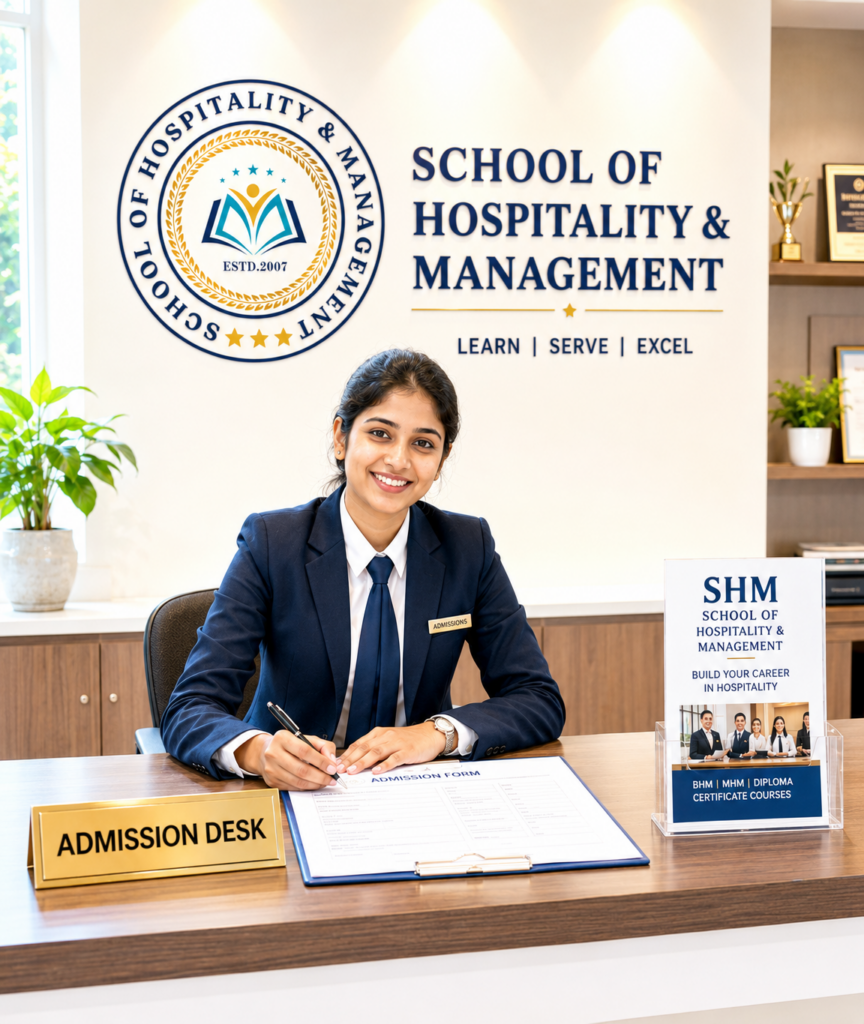
Students searching for the Best Hotel Management College in West Bengal should prioritize institutions equipped with these professionally designed spaces. The confidence developed through repeated practical service enables graduates to adapt rapidly during internships. To explore how these premium facilities operate in practice, prospective students can explore the state-of-the-art infrastructure at the School of Hospitality and Management.
Fully Equipped Mock Bar Setups: Beverage Science and Creativity
The global beverage industry has rapidly evolved into one of the most innovative and profitable segments within modern hospitality. Luxury hotels increasingly emphasize premium beverage experiences, molecular mixology, artisanal ingredients, and immersive guest engagement. Consequently, professionally designed Mock Bar Laboratories have become indispensable for any serious curriculum.
Students enrolled in Hotel Management after 10+2 receive comprehensive practical exposure to commercial bar operations. These realistic training counters are fully equipped with professional glassware, pressurized dispensing systems, cocktail stations, and specialized refrigeration units.
The educational objective extends far beyond basic drink preparation. It encompasses the scientific, managerial, financial, and psychological aspects of beverage service. Training modules introduce learners to deep mixology principles, molecular beverage preparation, flavor balancing, and complex botanical extractions.
Furthermore, students gain valuable insights into beverage costing, inventory control, stock rotation, and procurement planning. These competencies are particularly relevant within luxury hospitality environments, where beverage sales contribute substantially to overall departmental revenue.
Mastering Flair and Professional Bar Discipline
The laboratory also provides structured, supervised instruction in flair bartending. This niche training enables students to develop hand-eye coordination, precision, and highly engaging guest communication skills. Therefore, institutions recognized as the Best Hotel Management College in West Bengal invest heavily in these specialized Mock Bar Laboratories.
This experiential learning vastly enhances communication abilities while constantly reinforcing the absolute importance of safety, professionalism, and operational discipline. Graduates who master these bar operations find themselves in high demand across cruise ships, exclusive resorts, and high-end metropolitan lounges.
Advanced Beverage Dispensing Systems and Digital Technology
Digital innovation has completely transformed beverage production and service within modern hospitality organizations. Automated dispensing technologies drastically improve operational efficiency, maintain strict product consistency, minimize wastage, and optimize inventory control. As a result, advanced beverage dispensing laboratories represent an essential component of progressive hospitality education.
These cutting-edge laboratories expose learners to commercial post-mix systems, draught beverage technologies, commercial espresso machines, and nitrogen coffee dispensers. Furthermore, students frequently interact with automated cocktail stations and intelligent beverage monitoring platforms.
They develop profound technical competence in equipment calibration, gas pressure regulation, temperature management, and operational troubleshooting. Practical familiarity with advanced beverage technology enables graduates to adapt seamlessly to digitally integrated hospitality environments.
Students also examine how automation directly contributes to labor productivity, quality assurance, and financial performance. By aggressively reducing operational inefficiencies, these technologies ensure standardized, high-quality product delivery every single time. Consequently, Hotel management after 12th offers students a unique opportunity to combine traditional hospitality values with cutting-edge digital innovation.
Dedicated Sommelier and Wine Tasting Laboratories
Wine service represents one of the most prestigious and intellectually demanding disciplines within Food and Beverage operations. Luxury hotels, premium restaurants, and international hospitality brands increasingly seek professionals capable of guiding guests through highly sophisticated beverage experiences. Therefore, dedicated Sommelier and Wine Tasting Laboratories provide vital specialized practical education.
Within these specialized sensory evaluation laboratories, students systematically develop their palate. They learn to identify distinct aroma profiles, flavor characteristics, acidity levels, tannin structure, and overall balance through structured tasting methodologies.
These educational exercises frequently include rigorous non-alcoholic tasting techniques to build a vast sensory vocabulary while maintaining strict academic focus. Students deeply explore the geographical diversity of global vineyards, specific grape varieties, climatic influences, and historical production methods.
Furthermore, they intensely study cellar management, accurate service temperatures, delicate decanting procedures, and perfect food pairing strategies. This multidisciplinary education seamlessly integrates gastronomy, chemistry, agriculture, and luxury service management into one comprehensive skill set.
Cultivating Elite Guest Communication
Equally important is the heavy emphasis on refined guest communication. Learners practice recommending appropriate beverages based on complex menu composition, guest preferences, and nuanced cultural expectations.
Such elite interpersonal competencies significantly enhance guest satisfaction. They heavily reinforce the highly personalized service philosophy central to luxury hospitality. The Best Hotel Management College in West Bengal will always feature a dedicated Sommelier Laboratory because it drastically broadens students’ professional capabilities.
By acquiring internationally relevant beverage expertise, graduates can easily support high-paying careers in luxury hotels, cruise hospitality, fine dining restaurants, beverage consultancy, and upscale airline catering.
Mock Banquet and Theme Event Spaces
Banquet operations constitute one of the most strategically important revenue centers within modern large-scale hotels. Corporate conferences, destination weddings, diplomatic receptions, gala dinners, and international conventions require exceptional organizational capability. Therefore, Mock Banquet and Theme Event Spaces provide students with invaluable opportunities to experience large-scale hospitality management.
Students pursuing Hotel Management after 10+2 participate in every single stage of massive event execution. This rigorous process includes client consultation, theme event planning, banquet layout design, exact seating optimization, and lavish décor planning.
Moreover, they learn to meticulously manage buffet engineering, heavy equipment coordination, audiovisual integration, and strict guest flow control. Practical exposure to these intense activities develops leadership, teamwork, crisis management, and rapid decision-making skills that cannot be taught in a standard classroom.
The Business of Large-Scale Event Execution
The educational process also rigorously incorporates detailed banquet costing, menu pricing strategies, labor scheduling, massive procurement planning, and supplier coordination. Students understand exactly how successful banquet operations contribute to massive hotel revenue spikes.
Event management has emerged as one of the absolutely fastest-growing sectors within global hospitality. By mastering these large-scale operations, students are perfectly positioned to pursue lucrative careers in destination management companies and international corporate event organizations.
For institutions striving to provide the highest tier of education, realistic banquet simulation significantly enhances graduate employability. Through continuous, high-pressure practical exposure, learners quickly develop the unwavering confidence required to excel within the dynamic global hospitality industry.
Integrating Cloud POS and PMS Ecosystems
In today’s fast-paced operational environment, F&B service never exists in isolation. It is deeply and digitally connected to the hotel’s central operational brain. Modern training facilities teach students exactly how to operate cloud-based Point of Sale (POS) systems and connect them flawlessly with Property Management Systems (PMS).
For instance, when a guest orders a complex customized beverage at the mock bar, the student must digitally route that specific order to the kitchen display system (KDS). They must then ensure the charge seamlessly and accurately posts to the guest’s simulated room folio in the PMS.
This exact digital workflow is precisely what happens in a Marriott, Hilton, or Hyatt property. Practicing this in a simulated, consequence-free environment prevents costly billing errors in the real world.
Students quickly learn the critical importance of data security, digital menu updates, and automated inventory depletion. Therefore, when evaluating the Best Hotel Management College in West Bengal, one must strictly check if their F&B labs feature modern digital POS integrations, as this drastically increases a graduate’s immediate employability.
Nurturing F&B Entrepreneurship and Startups
Not every hospitality graduate wishes to work exclusively for an established corporate hotel chain. Many ambitiously aspire to launch their own premium cafés, dynamic cloud kitchens, or boutique restaurant brands. Advanced simulation laboratories serve as the absolute perfect incubators for these entrepreneurial ambitions.
Within the training restaurant, students can safely test out original, innovative business models. They can engage in deep menu engineering, experimenting with varied pricing strategies to clearly see what yields the highest profit margin. By independently operating the mock bar or banquet space, they learn the harsh realities of supply chain management, vendor negotiations, and aggressive overhead cost reduction.
Institutions that actively support this level of creative freedom deeply empower students to think like true business owners. Pursuing Hotel management after 12th in such an environment means a student graduates not just as a competent job-seeker, but as a confident potential job-creator. The practical financial lessons learned translate directly to the skills needed to launch a successful food startup in a competitive modern market.
The School of Hospitality and Management Advantage
Choosing the right institution definitively dictates the entire trajectory of a hospitality career. The School of Hospitality and Management specifically and intentionally integrates all these advanced F&B simulation models into its core academic curriculum. By prioritizing hands-on, deeply experiential learning, the institute ensures that every single student is industry-ready from day one.
Whether a student is exploring Hotel Management after 10+2 or seeking highly specialized culinary expertise, the modern infrastructure at SHM brilliantly bridges the gap between academic theory and commercial reality. Their dedicated training restaurants, advanced mock bars, and expansive banquet spaces brilliantly reflect the exact stringent standards demanded by top-tier global hotel chains.
By studying within these advanced facilities, learners are constantly challenged to elevate their service standards. They actively learn how to read guest body language, anticipate unstated needs, and deliver flawless service under immense pressure.
Conclusion: Securing a Future in Global Hospitality
The modern hospitality landscape is fiercely competitive and unforgiving to unprepared graduates. It specifically demands professionals who are not only theoretically sound but also practically flawless in their execution. Advanced Food and Beverage simulation facilities are the exact crucibles where these elite professionals are forged.
By completely immersing students in realistic, high-pressure, and technologically advanced environments, premier institutions completely eliminate the steep learning curve associated with initial industrial training.
For anyone looking to study at the Best Hotel Management College in West Bengal, the presence of these advanced, realistic simulation labs is the ultimate indicator of true educational quality. It transforms the noble pursuit of Hotel management after 12th from a simple academic degree into a definitive, powerful stepping stone toward lifelong global hospitality leadership. Ensure your chosen institution offers these vital facilities, and your path to an international hospitality career will be exceptionally clear.